Double-disc grinding is an extremely efficient grinding process that uses abrasive wheels that oppose one another, grinding and removing equal amounts of stock from both sides of a blank. The result is a flat aluminum or stainless steel machine-ready blank with tolerances. At Carolina Knife & Manufacturing, our double-disc grinding services can substantially reduce your pre-machining costs.
BENEFITS OF DOUBLE DISC GRINDING?
The primary advantage of double-disc grinding services is that metal blanks can be machined at twice the rate of conventional methods. Additionally, closer tolerances can be guaranteed that are attainable with either vertical or horizontal milling processes. Thinner and larger metal blanks are more likely to flex, thus the greater need for double-disc grinding.
There are also other benefits that double-disc grinding services provide, including a reduction of internal stress in many metals. With reduced stress, the stability of a machine-ready blank is improved for additional machining phases. Double-disc grinding is also very cost-effective for high-volume production, because of the savings in labor and machine hours.
Which Materials Can Double Disc Grinding Services Be Performed On?
Carolina Knife & Manufacturing can perform double-disc grinding on any of the following materials:
- Aluminum
- Bronze
- Steel
- Raw metal
- Ferrous or non-ferrous metals
- Stainless steel
- Tool steels
- Cast iron
- Mold plate
- Copper
- Virtually any material
Carolina Knife & Manufacturing provides double-disc grinding services to manufacturers and machine shops requiring the highest quality product available. Our double-disc grinders can quickly remove material on opposing planes.
What are the advantages of Double-Disc Grinding?
- Flatness and parallel tolerances to .0005”
- Smaller parts can actually be guaranteed within tenths
Workpiece capacity is up to 24 inches square.

FINE GRINDING
WHAT IS FINE GRINDING?
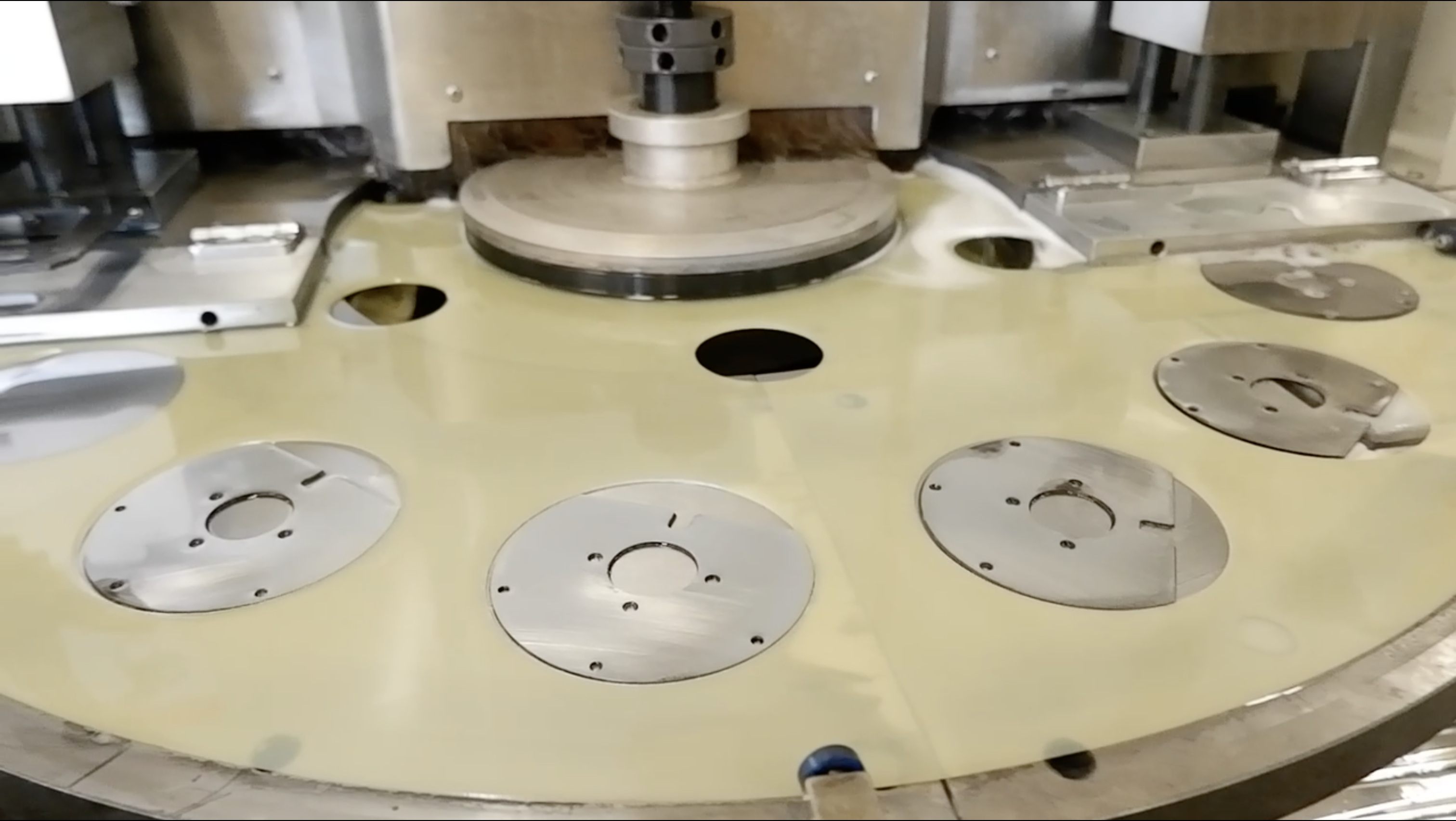
- Fine Grinding is a batch-mode abrasive machining process that combines the speed and aggressiveness of super abrasive wheels with the accuracy of lapping kinematics to produce flat and parallel workpiece surfaces.
- The cutting tool consists of an upper and lower wheel composed of diamond or cubic boron nitride (CBN) with different bond types (vitrified bond, resin bond, or metal bond) and acts as the support plates for the workpieces.
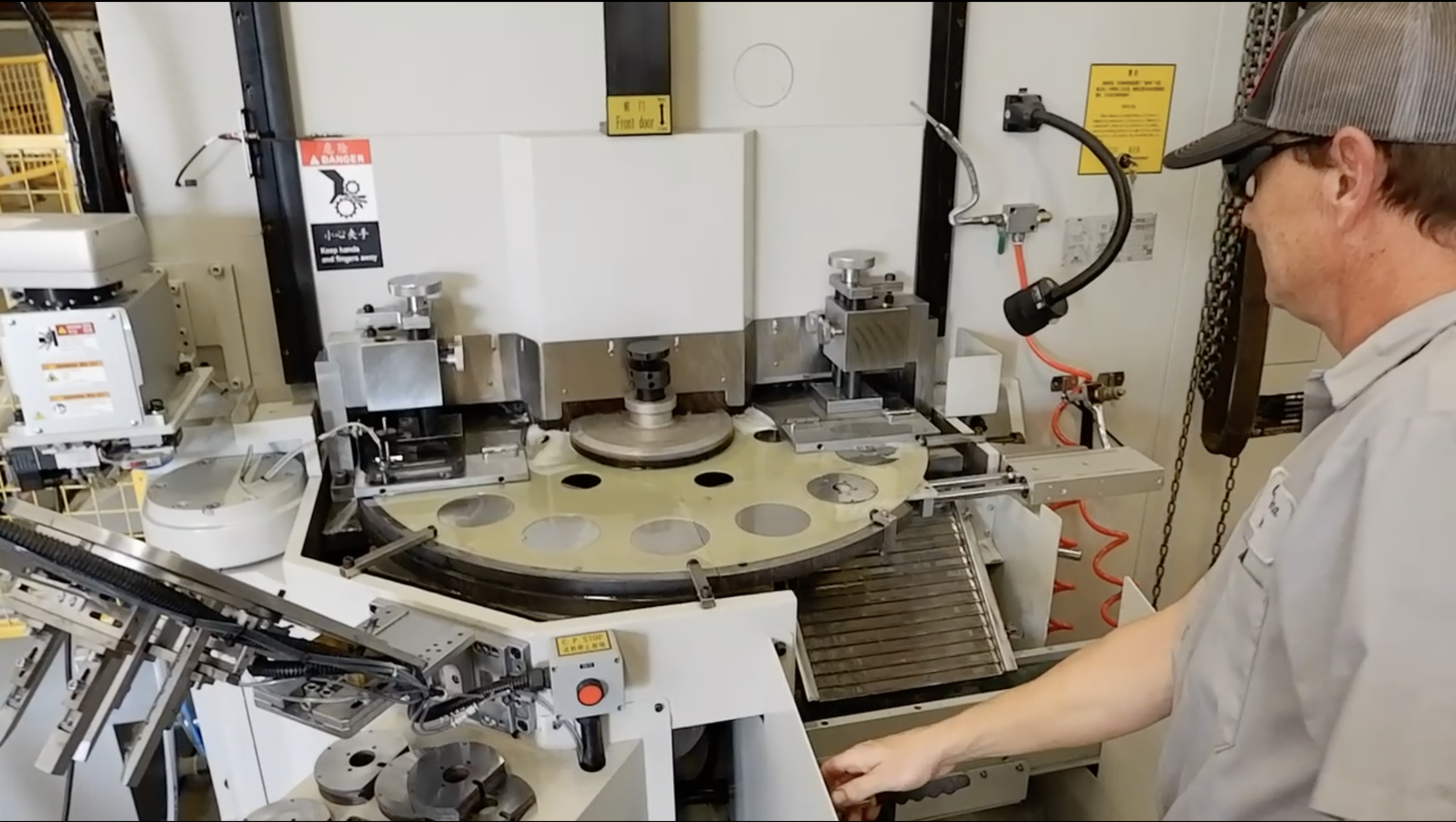
- The machine tool has evolved from the vertical double-wheel lapping machine design with a planetary work drive system known as “lapping kinematics”.
- In place of lapping wheels, grinding wheels are fitted and cooled through the labyrinth in the working wheels and a coolant is fed through holes in the upper wheel.
- Since Fine Grinding requires higher forces and uses higher cutting speeds, motors, gears and the rigidity of the machines are much stronger than lapping machines.
- Workpieces are guided between the upper and lower working wheel in an epicyclical path as defined by the inner and outer pin ring, upper and lower working wheel, speeds and directions, while material removal takes place simultaneously on both sides.
Why use Fine Grinding?

General
- Accuracy results, previously only achieved by lapping
- The pellet structure allows a layout of the grinding medium, corresponding to the kinematics conditions
- Long and constant process cycles without dressing processes
- The space between the pellets allows a high flow rate of the coolant
- Very good chip flow without temperature problems
- High process quality, consistent repeatability of achieved values
- Also, large surface workpieces can be machined
- Batch processing
- Workpieces are loosely held in carriers and therefore machined stress-free (without distortion - especially for machining of thin or delicate parts)
- Workpieces of different shapes could be machined (i.e. round, rectangular, or irregular; full surface or with cut-outs)
- Easily automated

Fast
- High removal rate using super abrasive diamond and CBN
(3 – 20 times faster than lapping) - Possible saving of pre-machining steps
- Long intervals between resharpening
- High flexibility
- Automated solutions

Clean
- Recycling of coolant
- Tremendous less waste than with lapping
- Minimal workpiece cleaning is necessary
- Reduced downtime
- Cleaning of workpieces without problems by rinsing; in comparison to lapping ultrasonic or chemical cleaning is not necessary

Economic
- High removal rate (reduces capital costs and personnel expenditure)
- Low wheel wear _ long lifetime of the grinding wheels (reduces the tool costs)
- Low waste disposal costs (reduces the current running costs)
- Low workpiece cleaning costs (reduces the current running costs)
- Possible saving of additional machining steps
- Easy wheel maintenance _low tool manufacturing costs by using a “Standard-Pellet-Form”
Fine Grinding
- Performed with super abrasive (diamond or cubic boron nitride - CBN) wheels
- Stock removal caused by micro grooving / -cutting
- The fine-ground surface has cross-hatched marks
Coolant is recycled - Fine-ground parts are coated only with a thin layer of coolant and therefore only minimal workpiece cleaning is necessary
- Wheel speeds are typically 2 – 15 m/s
- 3 – 20 times faster than lapping (removal rate)

Lapping
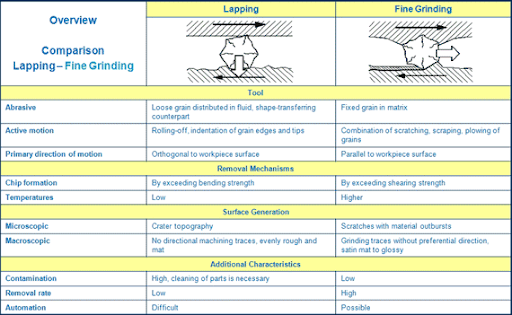
- Lapping is a working process, during which workpiece and tool slide over one another on a loosely applied medium (lapping compound) and are subject to continually changing direction of rotation.
- Stock removal caused by the rolling and sliding action of abrasive grains
- The lapped surface is dull and crater-like
- Material and lapping compounds are not recycled
- Lapped parts are contaminated with lapping compound and require cleaning
- Lapping speeds are generally limited to < 1 m/s
Definition of the Tooling Methods
- Lapping flat parts – single or double-sided) is the abrasive machining process for removing material using a loose abrasive in a liquid mixture (known as a slurry) at low speeds.
- Loose abrasive is moving over the surface under pressure (fig. 1), will knead, abrade, chip or scrape away the surface of the workpiece (fig. 2). By exceeding the bending strength the material breaks out.
- Fine Grinding (flat parts – single or double-side) is the abrasive machining process for removing material using a bonded Superabrasive wheel at low speed with a liquid to keep the part cool. The fixed grain of a geometrically indefinable cutting shape acts like a plow (fig. 3) and material is removed by micro-grooving /-cutting (fig. 4). The chip formation occurs by exceeding the shearing strength.
Fine Grinding vs Lapping